
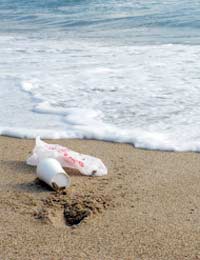
 You’d have to have been living on Mars not to notice the push recently for us to use less plastic bags. We’re given incentives to re-use them, re-cycle them, use bags for life, or not use them at all.
And yet they are still a major environmental problem.
Bag Facts
13 billion plastic bags are used each year and despite strenuous efforts to reduce this figure and pressure on large corporations to re-call and dispose of a certain proportion of them, the number is still rising.
In 2007 the government’s Department of the Environment, Defra, collated the following facts about plastic bags:
- 88% of shoppers put their shopping into free plastic bags which are given out by shops.
- An average of 300 bags per adult are used each year.
- We use an average of 3-4 bags each trip.
- 45% of shoppers have bought a bag for life – but only 12% use them.
All At Sea
By their very nature, plastic bags are lightweight and the right shape to easily blow away. Besides people dropping them, plastic bags catch the wind like sails and are whisked out of bins, landfill sites and council tips.
Plastic bags can travel many miles in this way but once they land on water, due to its surface tension, they remain there. This means that our seas and rivers are full of old plastic bags.
During the Marine Conservation Society’s Beachwatch survey for 2007, seven and a half thousand bags were recorded on UK beaches. This is an increase of two thousand within three years and the number is unfortunately still climbing, despite growing awareness of their environmental damage. It means that for every kilometre of beach surveyed, approximately 45 bags were found.
The Problem For Marine Life
The issue of bags landing in the sea, is not so much about the fact that they look nasty – which of course they do – but because they also pose a serious health hazard to many marine creatures, so much so that they are pushing some species closer to extinction.
What happens is that many types of sea life mistake the bags for food. This is most particularly the case with creatures for which squid or jelly fish are part of their natural diet. For a Leatherback turtle, for instance, a floating plastic bag looks almost indistinguishable to a jelly fish, and they attempt to eat the bag.
However ingestion and digestion is almost impossible and the bag either gets tangled in their stomach or completely blocks their gut, causing them to die a slow and painful death of starvation.
The Creatures Plastic Bags Harm Most
Research so far has shown 177 species of marine creature to have been adversely affected by swallowing plastic bags at sea. The list makes for alarming reading and includes whales, dolphins, harbour porpoises, puffins, seals, sharks, turtles, and sea birds such as the black footed albatross.
Amongst the worst affected are creatures who are already endangered and who, if they are not protected, could soon become extinct.
Records of dead animals from the Marine Conservation Society include an endangered Leatherback turtle which was found with 57kg of plastic bags blocking its insides and a rare Curviers Beaked Whale, whose gut was totally obstructed by compacted bags. A further incident reported a Minke Whale found washed up in France with 800kg of plastic bags inside it, including some from British supermarkets. These are just a few examples of a growing list.
Chemicals From Plastic
And there’s more bad news. It is not only the plastic itself which causes infection and death amongst these animals, but the chemicals in the plastic.
The high and low density polyethylene from which plastic bags are made, are full of chemicals which have been found to be able to migrate from plastic and thus contaminate other things. Such chemicals can affect the immune system of animals.
Bio-degradation Of Plastic Bags
Plastic might be convenient for us, but it is wrecking our planet. Scientists have estimated that it may take a plastic bag at sea to take anything from 450 to a thousand years to break down.
However, even then, it may never actually disappear. Tiny microscopic particles or ‘plastic dust’ could persist, going on to affect a whole new host of marine life such as filter feeders by which the plastic – and its inherent toxins – could be transferred up the food chain.
What You Can Do
- Don’t use plastic bags.
- If you must, make sure they are disposed of safely and cannot blow away.
- Pick up any plastic bag you see blowing around or stuck in hedgerows.
- Use only bags made of natural fabric or paper.





Leave A Comment